What is RoAMS?
RoAMS is Romania's Accelerator Mass Spectrometry laboratory, hosted at IFIN-HH. Built around a 1 MV TandetronTM accelerator from High Voltage Engineering Europe and a dedicated wet-chemistry facility, it is the only AMS installation in the country.
AMS is today's most sensitive method of isotopic analysis. Instead of waiting for radioactive atoms to decay, we use a particle accelerator to count them one by one. Combined with magnetic and electrostatic analysers and a high-resolution ion detector, this lets us reach rare/abundant isotope ratios as low as 1 in 1015—a single rare atom among one million billion others.
RoAMS is a laboratory registered with the journal Radiocarbon (laboratory code RoAMS), contributing to internationally recognised 14C measurements and part of the broader European AMS community of laboratories.
At a glance
- 1 MV Tandetron AMS, commissioned 2012.
- Sensitivity down to ~10−15 isotope ratio.
- Radiocarbon dating + cosmogenic and actinide AMS.
- Integrated wet-chemistry preparation lab.
- Laboratory code RoAMS, registered with the journal Radiocarbon.
One of the most interdisciplinary teams at DFNA
Where physics meets chemistry, geology, archaeology and environmental science
RoAMS is, by design, a meeting point of disciplines. The science we do needs every step to work: from carefully sampled material in the field, through painstaking wet chemistry on the bench, to the physics of the accelerator and detector, to the statistics and modelling that turn isotope ratios into ages, fluxes and concentrations.
As a result, our team brings together physicists, chemists, geologists, geographers, archaeologists and environmental scientists, working side by side—one of the most interdisciplinary teams in the department. We routinely collaborate with universities, museums, environmental agencies and other research institutes in Romania and abroad.
Beyond our internal team, RoAMS is plugged into the wider European AMS community: we share methodologies, reference materials and inter-comparison exercises with peer laboratories across Europe, ensuring that our measurements are traceable, comparable and trusted internationally.
Physics Chemistry Geology Geography Archaeology Environmental science Palaeoclimate Nuclear physics
Part of the European AMS community of laboratories — collaborating on methods, reference materials and inter-laboratory comparisons.
1 · Prepare it
From a field sample to a measurement-ready target
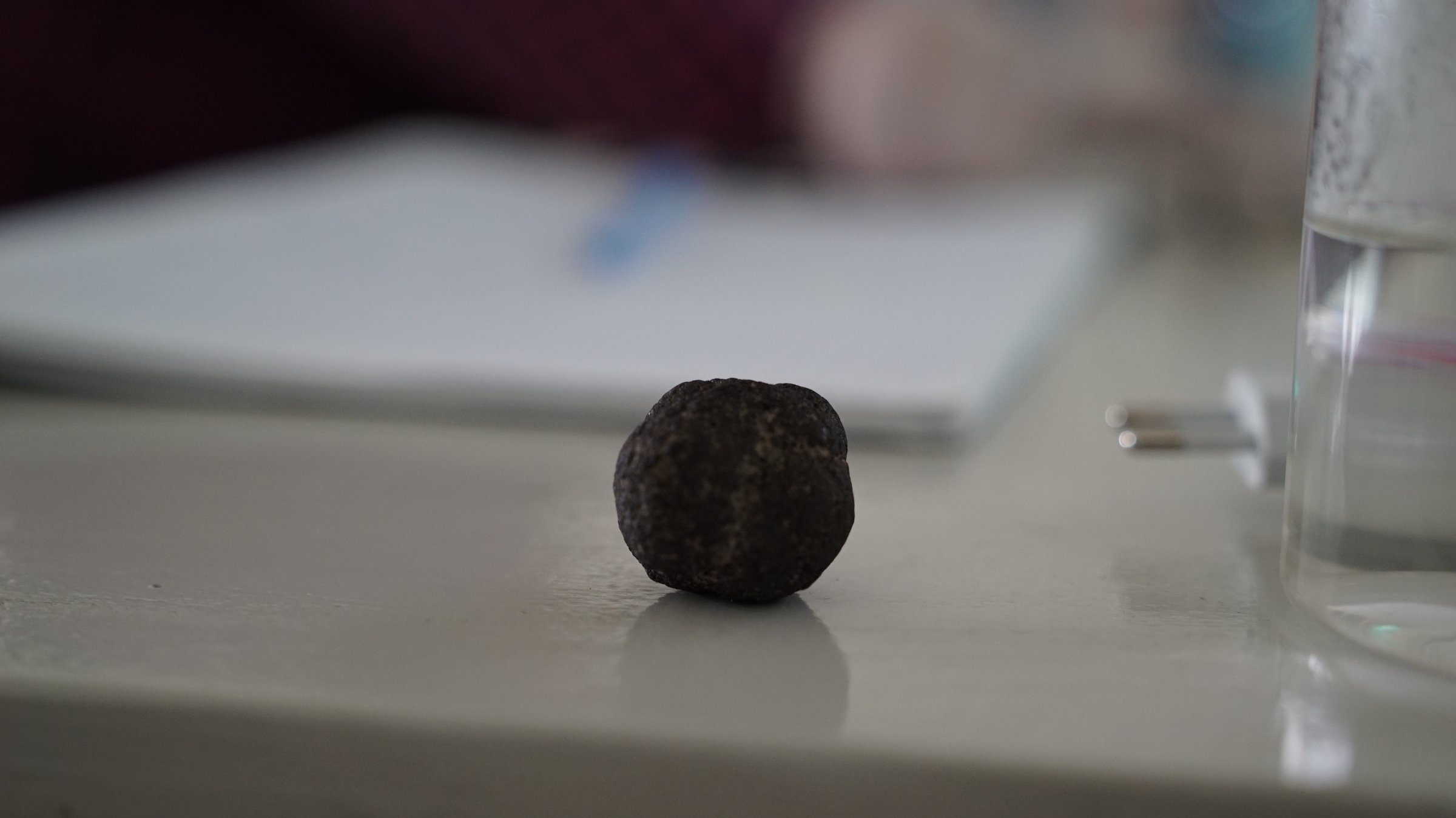
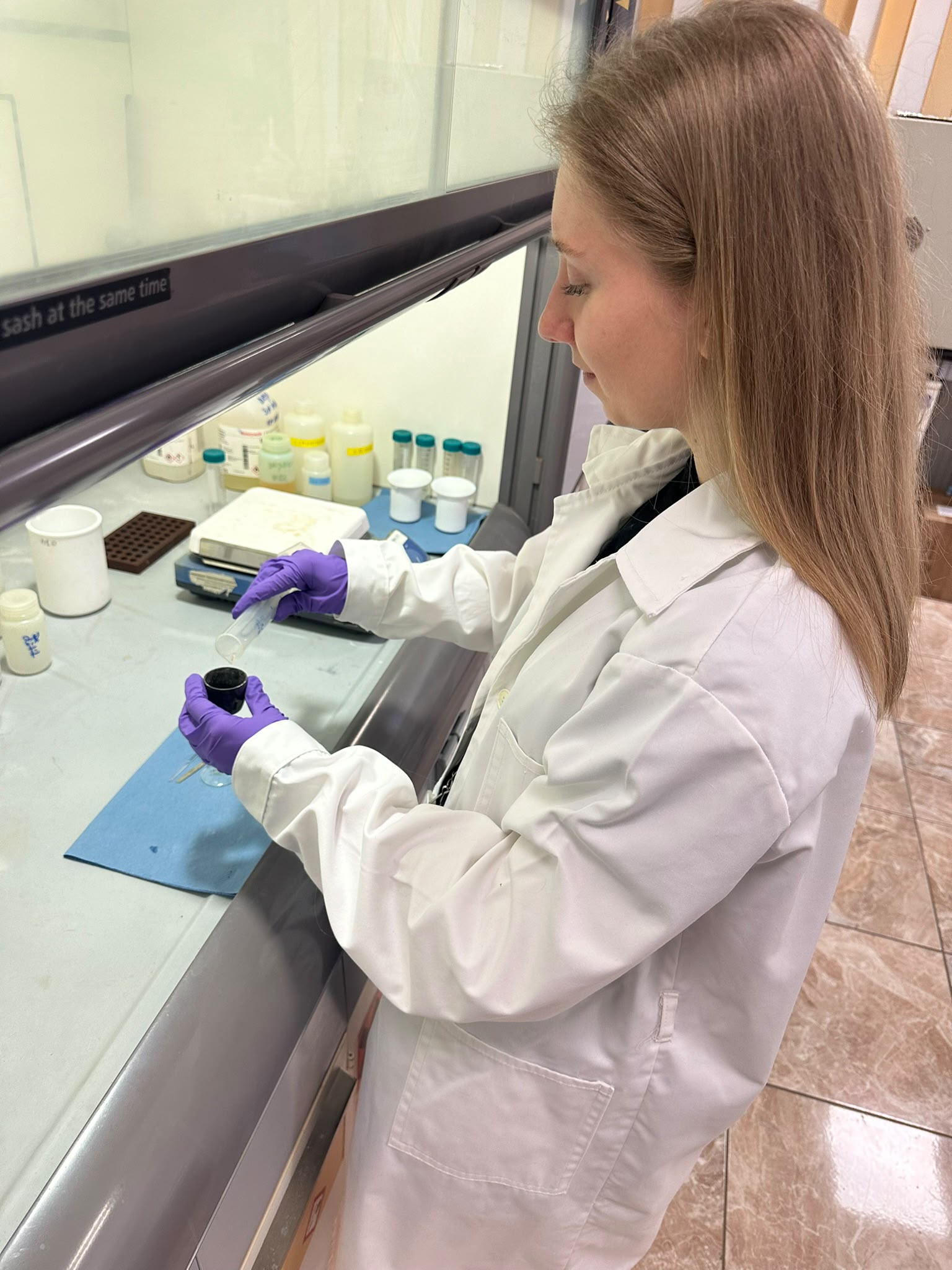
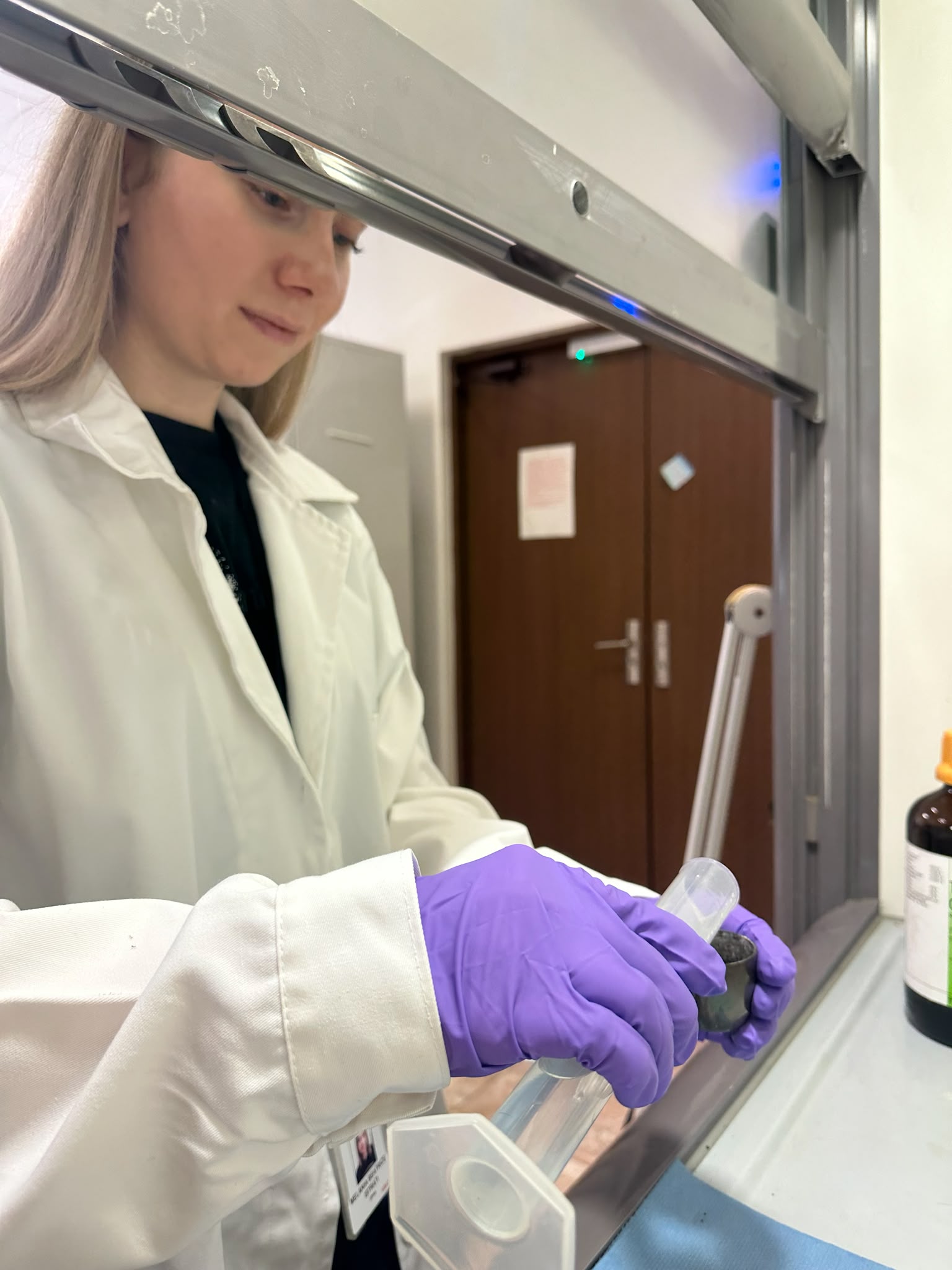
Every measurement begins as a physical thing—a sliver of bone, a handful of quartz, a litre of water—and the hardest part is often turning it into something the accelerator can read. That work happens on the bench, in our dedicated Chemistry Laboratory.
Each isotope has its own recipe. Organic material destined for radiocarbon is cleaned of contamination, combusted to CO2 and reduced to graphite. Quartz is dissolved and beryllium and aluminium separated by ion-exchange chromatography. Iodine and actinides each need their own extraction. The common thread is obsessive contamination control: when you are chasing one atom in 1015, a trace of modern carbon or stray beryllium can swamp the signal.
And it is frugal—most analyses need only milligrams of material. If you are planning to send samples, the sampling and packaging guidelines on the 1 MV page explain how much, and how to protect it.
2 · Count it
A particle accelerator that counts single atoms
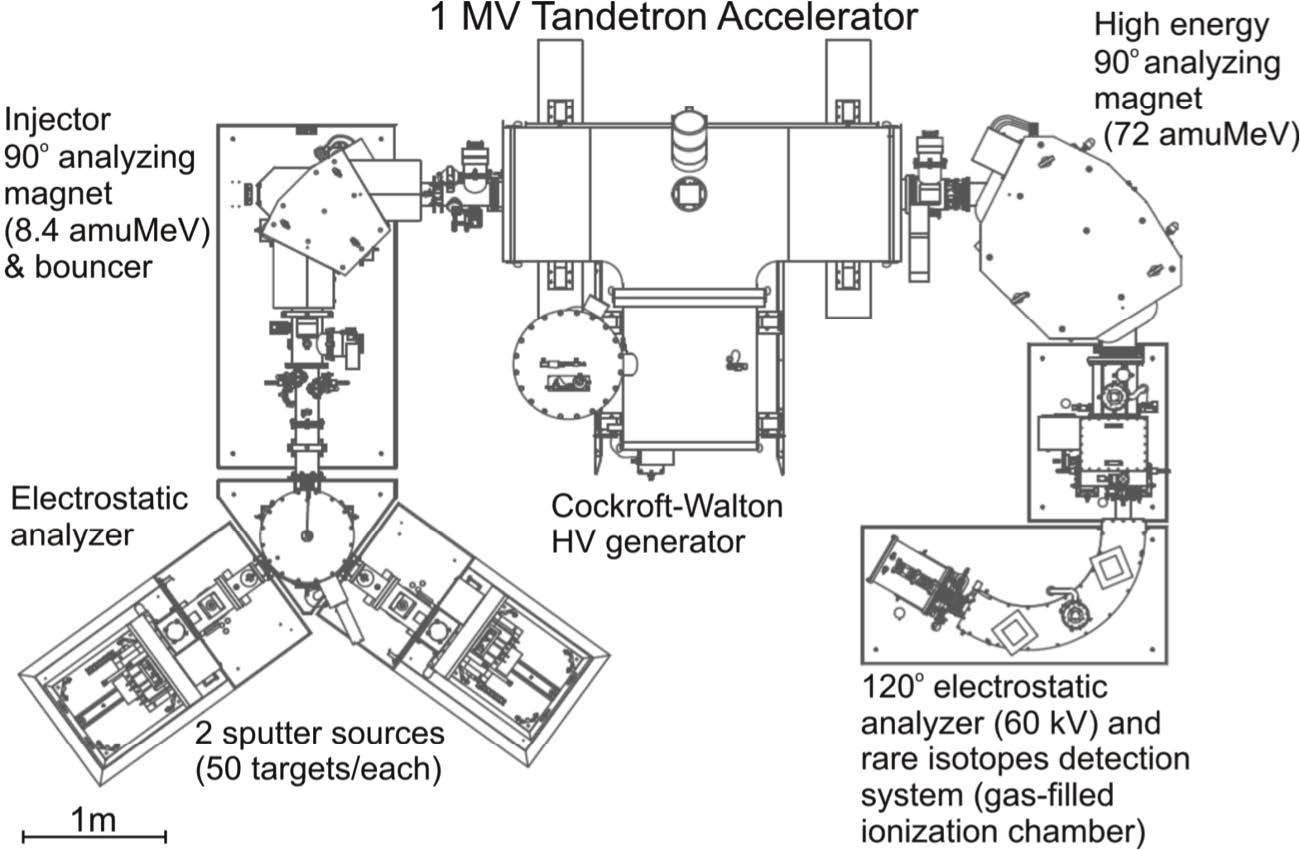
Conventional methods wait for radioactive atoms to decay and count the rare flashes. AMS does something bolder: it counts the atoms themselves, one by one. The prepared target is loaded into our 1 MV TandetronTM, ionised, and sent through a tandem accelerator that shatters the molecular look-alikes which would otherwise masquerade as the isotope of interest.
Magnetic and electrostatic analysers then sort the surviving ions by mass and energy, and a high-resolution detector tallies the rare atoms against the common ones. The result is a sensitivity that reaches 1 in 1015—the single rare atom hiding among a million billion others that gives this page its name.
It is fast and frugal compared with the old radiometric approach: smaller samples, shorter measurements, better precision.
3 · Read it
From isotope ratios to dates, fluxes and concentrations
A run ends with a number: how many rare atoms sat among the common ones. Reading that ratio is where physics becomes knowledge—and the questions it answers reach from deep time to the present day and out toward space. Radiocarbon dating is our best-known story and a genuine flagship—but it is one of several. The same machine lets us read landscapes, track pollution and probe cosmic processes, and those uses matter every bit as much.
14C 10Be 26Al 129I 239Pu 240Pu 2H 3H 41Ca
Dating & heritage Flagship
14C radiocarbon dating. First developed by Willard Libby (Nobel Prize, 1960), it exploits the fixed half-life of 14C (5730 years) to date once-living material—wood, charcoal, bone, textiles, peat, carbonates and shells—back roughly 50,000 years. The backbone of modern archaeometry, offered at RoAMS under its laboratory code registered with the journal Radiocarbon.
Serves archaeology, history and environmental chronology.
Geosciences & landscapes
Cosmogenic 10Be and 26Al, produced when cosmic rays strike surface minerals, give surface-exposure ages, erosion rates and burial histories.
Reconstructing how landscapes and glaciers evolved—even in Antarctica.
Environment & safety
Anthropogenic 129I traces nuclear-industry releases and ocean circulation; 239Pu and 240Pu enable ultra-trace pollution forensics.
Tracking contamination through air, water and soil.
Hydrology & biomedicine
Hydrogen isotopes 2H and 3H support water-cycle and fusion-relevant studies; 41Ca is a sensitive biomedical tracer for bone-metabolism research.
Following water and elements through living and natural systems.
Space & cosmogenic
Because many of these nuclides are made by cosmic rays, measuring them feeds research into cosmic-ray history, extraterrestrial materials and the nuclear processes that shape the cosmos.
Reading signals written by the cosmos.
All powered by chemistry
Each isotope's reading depends on its own separation recipe—quartz dissolution, Be/Al ion-exchange, iodine extraction, actinide separation—developed in our Chemistry Laboratory.
No measurement without the bench work.
Linked infrastructure
RoAMS = accelerator + chemistry, working as one
Work with RoAMS
Sample submission, joint projects and training
RoAMS welcomes academic and industry partners across all the fields above. Whether you need a one-off radiocarbon date, a cosmogenic-isotope chronology, or a long-term methodological collaboration, we are open to enquiries.
Students are also a core part of the lab: several internships and thesis projects each year run through RoAMS and the Chemistry Lab via the DFNA student programme.