A beam that both reads and rewrites matter
An accelerated ion beam is a rare kind of tool: aim it gently and it becomes a probe that tells you exactly what something is made of; turn it up and it becomes a chisel that re-engineers a material atom by atom. At the 3 MV Tandetron we do both.
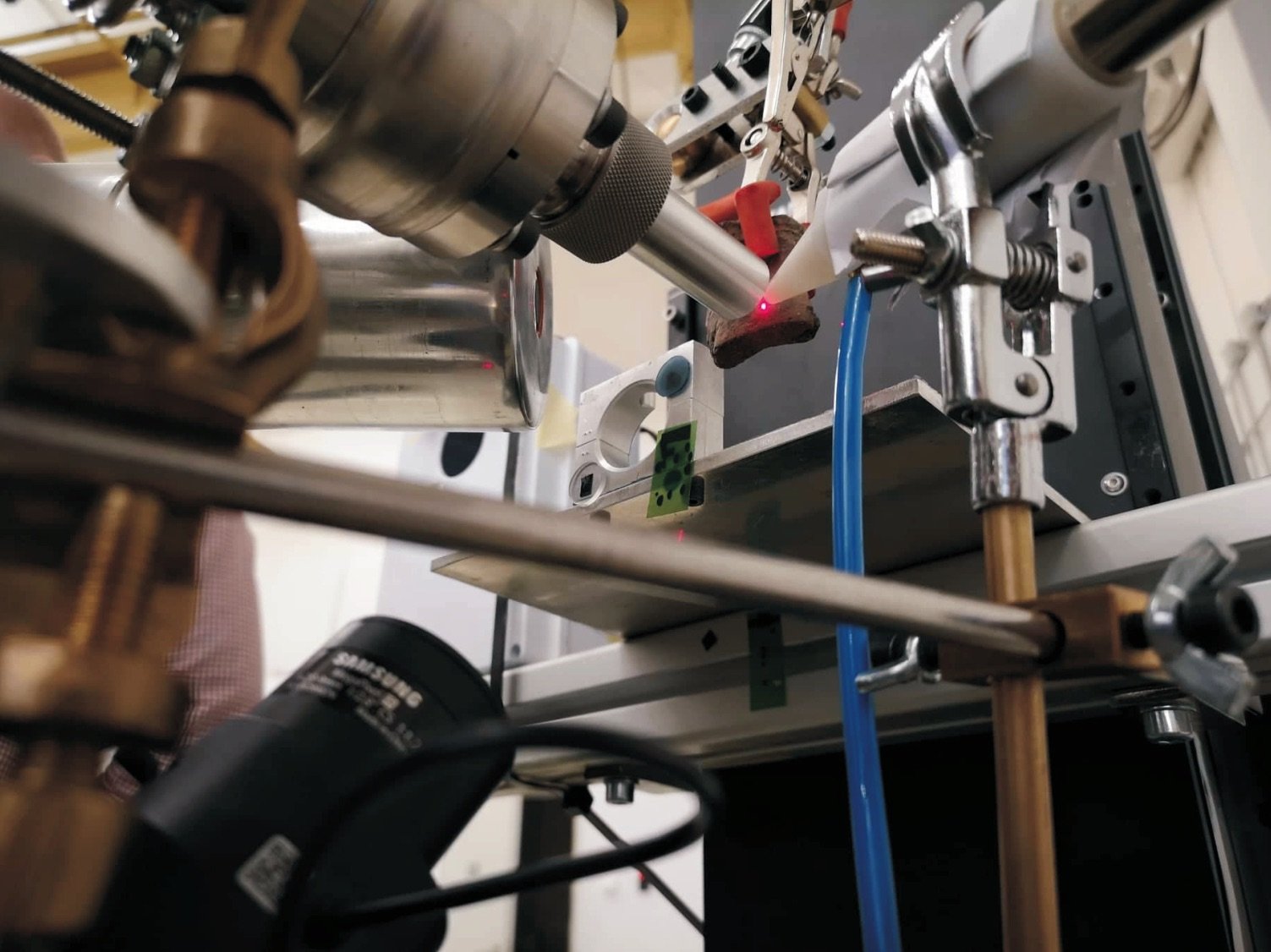
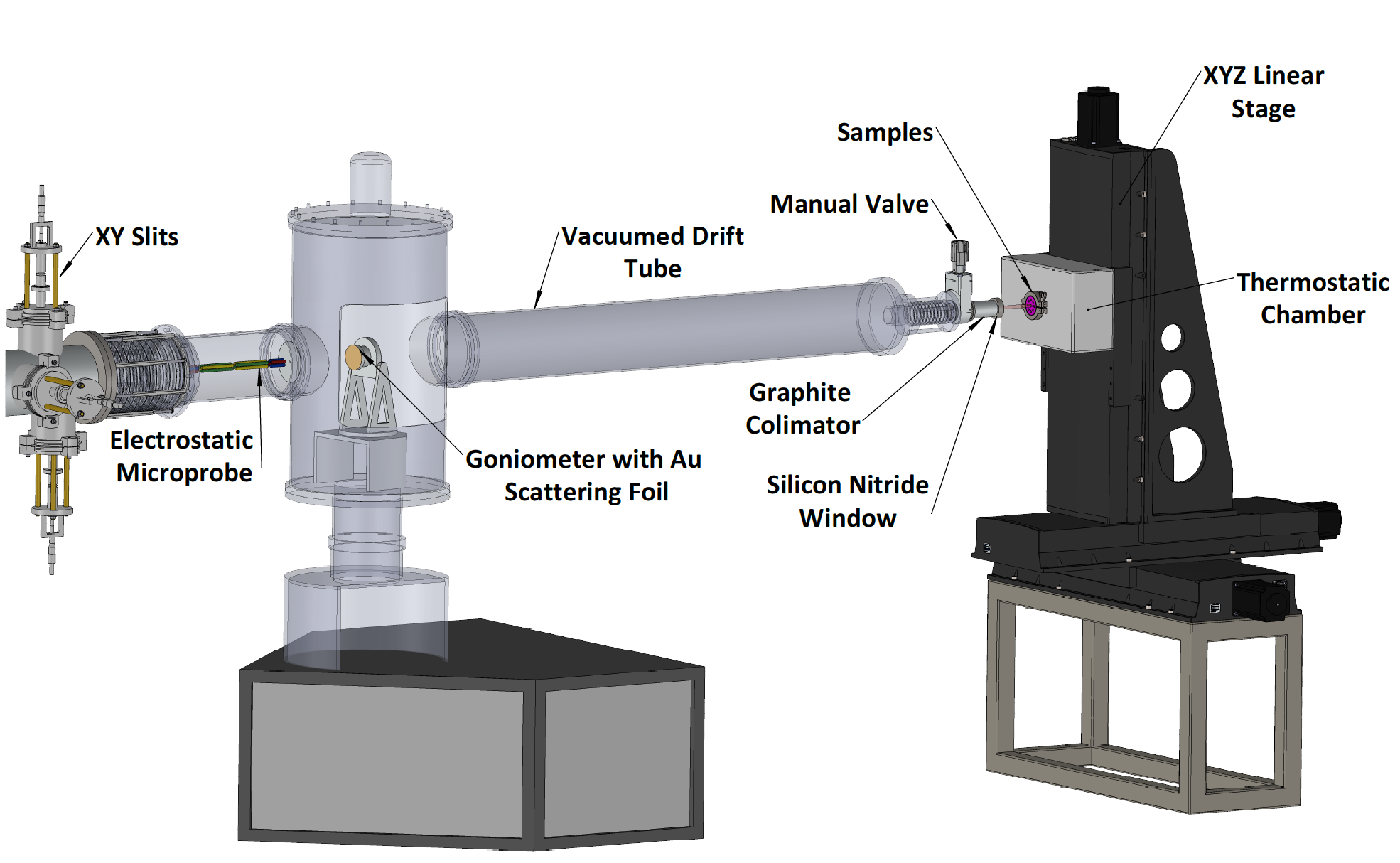
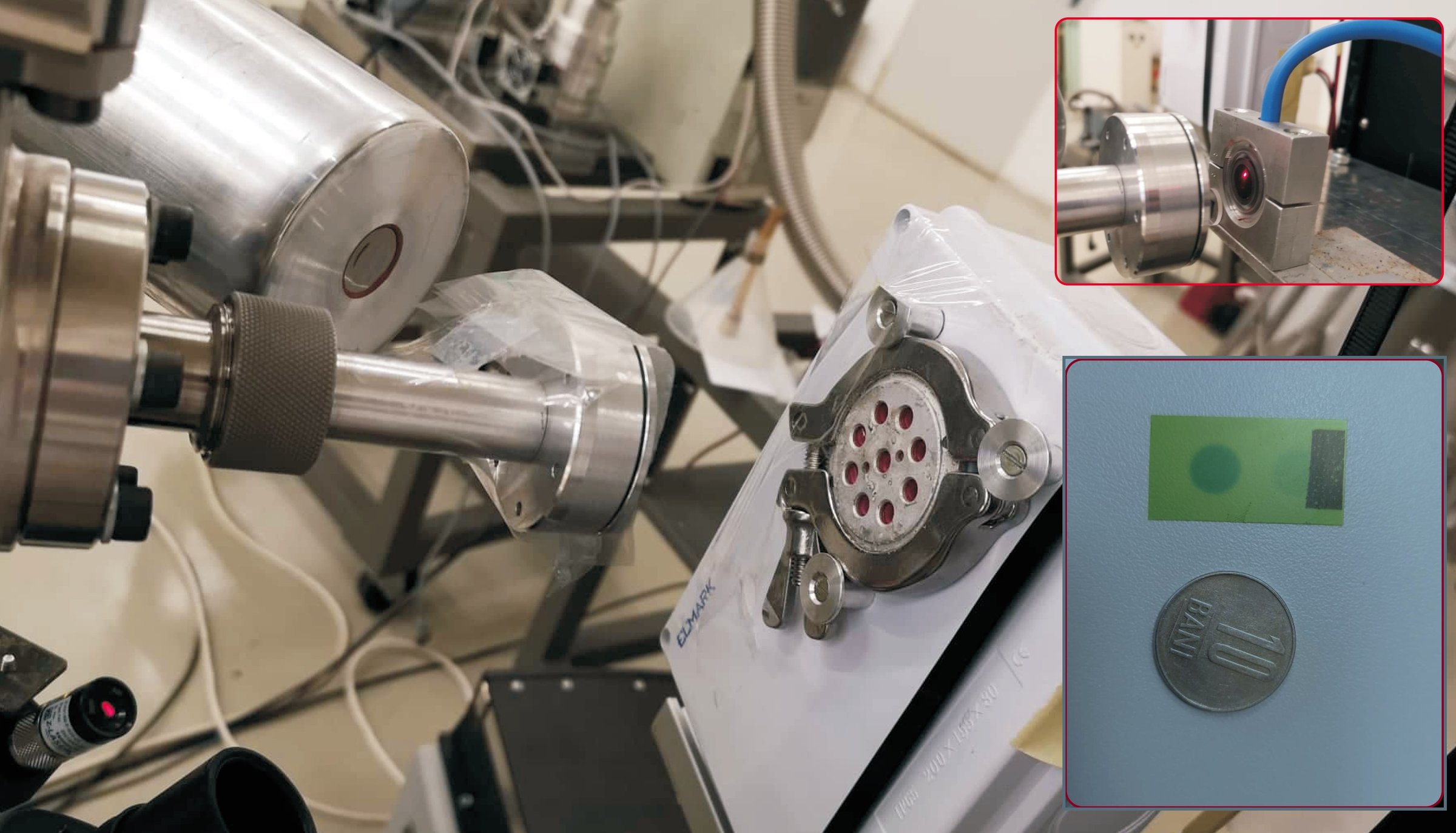
We extend the accelerator with bespoke micro-ion-beam instrumentation for high-resolution, non-destructive work across archaeometry, materials science and radiobiology. A defining capability is our 3 MeV proton beam delivered in air—so a painting, a meteorite or a living cell culture can be studied in situ, no vacuum chamber required.
The story of this direction is three verbs: analyse what matter is, engineer what it can become, and test how it survives radiation.
1 · Analyse it
Reading elemental composition without touching a thing
Point the beam at a sample and its atoms answer back—emitting characteristic X-rays and scattering the incoming ions in tell-tale ways. Reading those signals with techniques such as PIXE, RBS and ERDA turns the beam into a sensitive, non-invasive probe of what something is made of, from major elements down to trace levels.
Because the beam can be brought out into open air and focused to a micro-spot, we can map composition point-by-point across objects that could never go into a vacuum: cultural-heritage artefacts, environmental samples, meteorites, advanced materials and even pharmaceutical products—all without leaving a mark.
The same micro-beam line supports single-ion implantation and micro-patterning, so the very instrument that reads a sample can also write on it.
What makes it powerful
- Non-destructive: unique artefacts and sensitive materials are preserved.
- In air or in vacuum: large/delicate objects in air; high-precision work under vacuum.
- Micro-scale resolution: precise positioning for point-by-point mapping.
- Trace sensitivity: elemental detection from bulk down to trace levels.
Typical beam
~10 nA current — enough for well-controlled dose and high measurement sensitivity.
2 · Engineer it
Re-writing a material's properties, ion by ion
Turn the beam up and it stops asking questions and starts making changes. By driving chosen ions—H, He, O, Cu, Nb, Ag, Au—into a material, we tailor its electrical, optical and mechanical behaviour with a precision chemistry alone can't reach. An insulating polymer can be coaxed into conducting; a surface can be hardened against wear and radiation.
One of our most distinctive research lines creates nano-channels—"ion tracks"—in perovskite oxides such as KTaO3. Each energetic ion carves a column of controlled damage just nanometres wide, opening a route to optical waveguides, nano-devices and bespoke nano-structuring.
This is materials design as a contact sport between physics and chemistry—and it feeds directly into our work with characterisation and radiation testing, where every modified sample is imaged and verified.
What the beam can change
- Electrical: implantation turns insulating polymers into conductors.
- Structural: light ions form precise micro-channels for microfluidics and sensing.
- Mechanical: heavy-ion bombardment boosts radiation tolerance and durability.
- Functional: X-ray shielding and micro-patterning for advanced devices.
Research focus
Defect interactions in KTaO3 perovskites, building stable nano-channels for optics and nano-devices.
3 · Test it under radiation
How cells, components and materials hold up
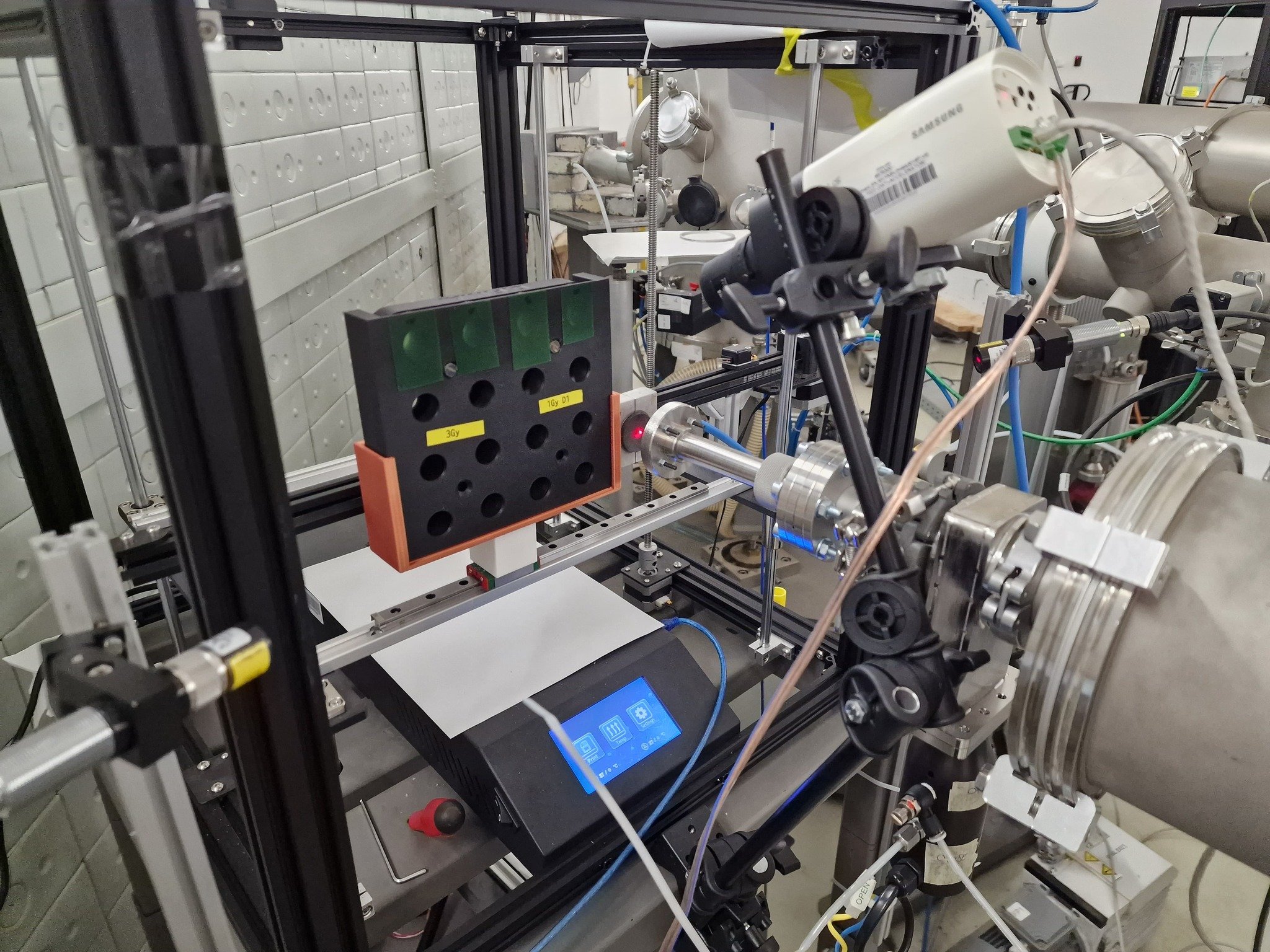
A beam that delivers a precisely known dose is also the perfect way to ask: what does radiation do to this? The 3 MeV proton beam lets us irradiate biological samples under controlled conditions to study cellular response, and to qualify electronic components destined for harsh, high-radiation environments.
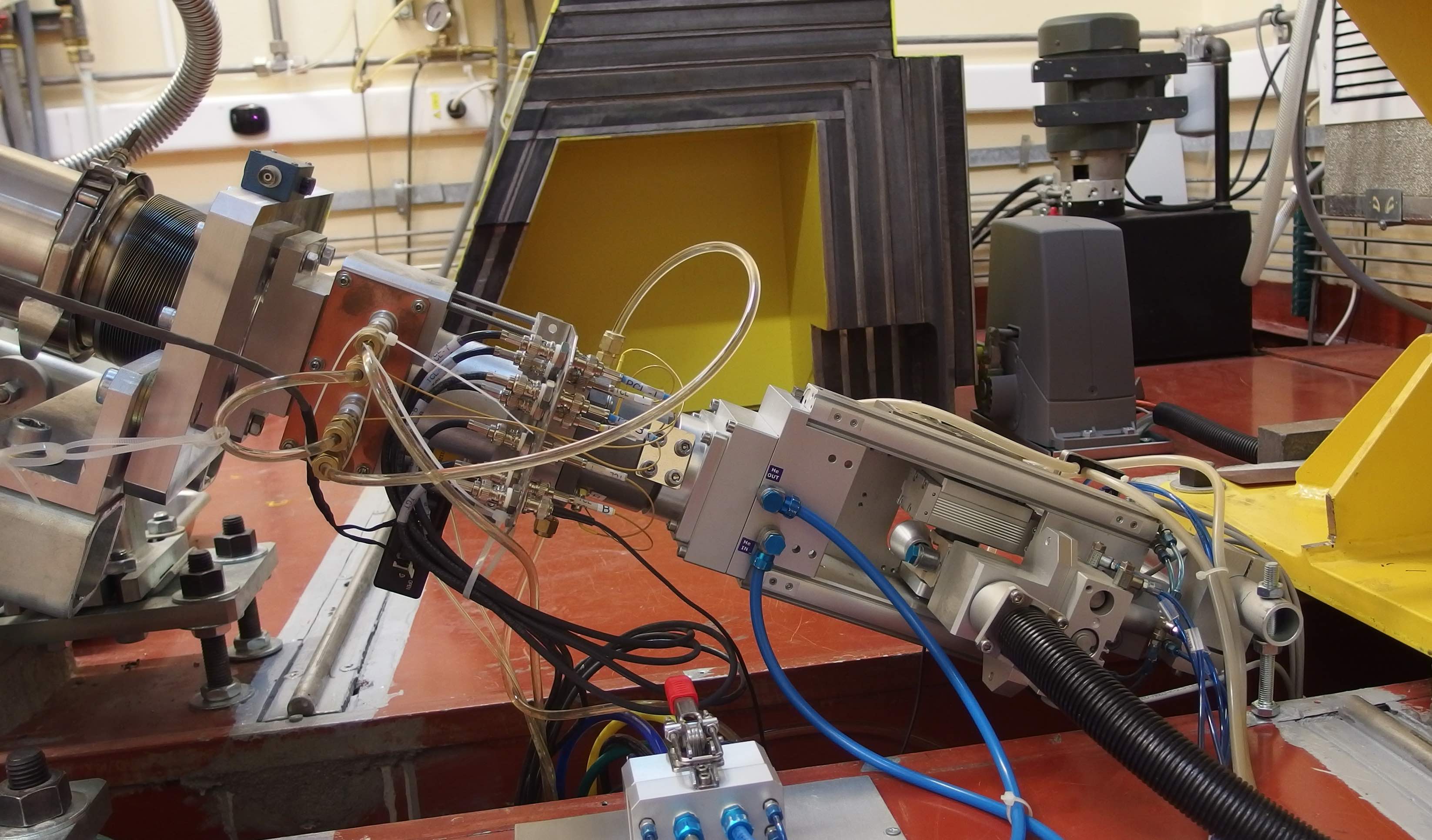
This work extends to the TR-19 cyclotron, where alongside producing medical radioisotopes we develop dedicated neutron beams and run radiation-hardness studies for nuclear and aerospace applications—with synergies reaching toward ELI-NP and research into extreme environments for energy and space.
Radiation testing & the cyclotron
- Radiobiology: controlled-dose proton irradiation of cells and tissues.
- Electronics qualification: components tested for radiation-hard environments.
- Neutron beams: dedicated beams for irradiation and activation studies.
- Materials for extremes: radiation-hardness for nuclear, aerospace and ELI-NP-relevant research.
Medical spin-off
The TR-19 also produces positron emitters (11C, 13N, 15O, 18F) for PET-CT imaging.
Who this serves
One beam line, many fields
Heritage
In-air PIXE mapping of artefacts and artworks without sampling or damage.
Materials & electronics
Nanocomposites, ion-track nano-channels and radiation-hardness qualification.
Radiobiology
Controlled-dose proton irradiation for cellular-response studies.
Space & energy
Testing materials and components for extreme radiation environments.